

Narrative OS: Don't Write Prompts, Plot Conversations
Iteration is crucial, so why do most still plan for one & done use?

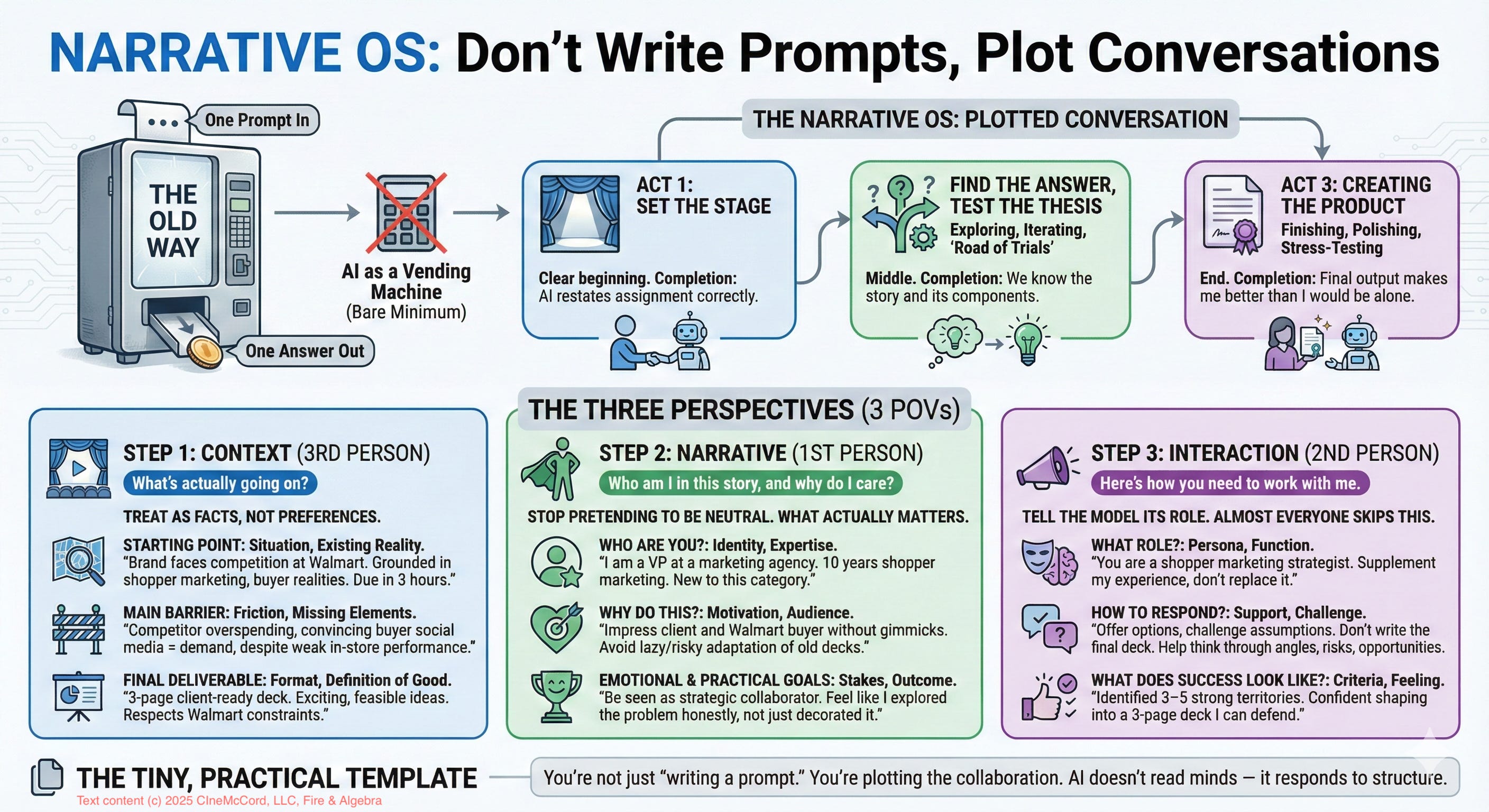
Most people still treat AI like a vending machine:
One prompt in → One answer out.
Anyone who has actually collaborated with AI knows that’s the bare minimum.
The good stuff comes from iteration, context, and clarification — which means the real unit of work isn’t a prompt.
It’s a conversation.
So instead of asking “What prompt should I use?”, start asking:
What story am I entering with this AI — and what’s the plot?
That’s what a Narrative OS does: it turns any AI task into a plotted conversation with a clear beginning, middle, and end.
The easiest way to build a conversation with a narrative OS is with three perspectives:
3rd person → Context / Ethics / Canvas
1st person → Narrative / Motivation / Stakes
2nd person → Interaction / Goal / Recursion
Think of it as giving the AI:
The stage (3rd person)
The protagonist (1st person)
The director’s notes (2nd person)
This works because AI doesn’t read minds — it responds to structure. Give it a story to step into, and it becomes a collaborator instead of a calculator.
The 3 steps below give a good framing, not for a request, but a project brief. To be effective, you must always expect at least 3 acts in every conversation, and these sequential phases can help explore the perspectives needed.
Act 1: set the stage.
Completion = the AI can restate the assignment back to you clearly and correctly.
Act 2: Find the answer, test the thesis - exploring, iterating, “road of trials”
Completion = we know what story we’re telling and what goes in it.
Act 3: Creating the product: finishing, polishing, stress-testing
Completion = the final output makes me better than I would be alone.
While the most complete Narrative OS (for calibration, not conversation) takes into account the evolving collaboration with AI, additional history, and your broader journey, this provides an easy perspective to get immediate benefit for most use cases.
Step 1: Context (3rd person) — “What’s actually going on?”
Write this in 3rd person so the AI treats it as facts, not optional preferences.
Answer three questions:
What is the starting point?
What exists already? What’s the situation?
“This new chocolate brand is facing steep competition from a new entrant, and the team needs a plan to defend its position at Walmart. All responses must be grounded in shopper marketing expertise, Walmart-specific realities, and maintain a strong buyer relationship. The recommendation is due in 3 hours.”
What’s the main barrier?
Where is the friction? What has gone wrong or is missing?
“The competitor is overspending and has convinced the buyer that their social media presence equals market demand, despite weak in-store performance.”
What is the final deliverable?
What format, and what does “good” look like?
“The final output is a 3-page client-ready deck that gives the buyer a reason to be excited to partner with this brand, with clear, feasible ideas that respect Walmart’s constraints.”
Step 2: Narrative (1st person) — “Who am I in this story, and why do I care?”
Now switch to 1st person. This is where you stop pretending to be neutral and tell the system what actually matters.
Answer:
Who are you in this situation?
“I am a VP at a marketing agency, assigned to build this plan for a new client. I don’t know this category well, but I’ve done shopper marketing for a decade through the shift to retail media.”
Why are you doing this? For whom?
“I want to impress both the client and the Walmart buyer without resorting to gimmicks. Normally I’d pull old decks and adapt them, but that feels lazy and risky here.”
What do you want out of this — emotionally and practically?
“I need the client to see me as a strategic collaborator, not a vendor. I want to feel like I’ve explored the problem honestly, not just decorated it.”
This is your story inside the assignment.
It gives the AI a sense of stakes, not just tasks.
Step 3: Interaction (2nd person) — “Here’s how you need to work with me.”
Now talk directly to the AI in 2nd person. This is the part almost everyone skips.
You’re not describing yourself anymore. You’re telling the model:
“Here is your role. Here is your job. Here is how we’ll know you’ve done it well.”
Answer three things:
What role should it play?
“You must act as a shopper marketing strategist who understands Walmart, retail media, and buyer psychology. You are here to supplement my experience, not replace it.”
How should it respond and support you?
“You should offer options and challenge my assumptions, not just agree. Don’t write the final deck. Help me think through angles, risks, and opportunities, then structure the story.”
What does success look like?
“You will know you’ve succeeded when we’ve identified 3–5 strong, feasible territories and I feel confident shaping them into a 3-page deck I can defend in a room with a buyer.”
These 3 steps not only give you a strong starting prompt, but they frame them in a way that provides extra clarity for the AI collaborator. By using the 3 POVs, and creating a beginning, middle, and end for each one, it is clear where the conversation needs to take the user, the AI, and the output.
The Tiny, Practical Template
When you start an AI session, write three short blocks:
Context — 3rd person (facts):
“This project is about…
The main challenge is…
The final deliverable must…”
Narrative — 1st person (you):
“I am…
I’m doing this for…
I care about…”
Interaction — 2nd person (instructions):
“You must…
You should…
You will know you’ve succeeded when…”
Paste that at the start of any conversation.
You’re not just “writing a prompt.”
You’re plotting the collaboration.
That’s the Narrative OS: a simple way to make sure the AI understands the story it is stepping into, not just the text you typed.