

Fast or Friction? A Method for Meta-Reasoning.
Balancing Context through Deliberate Consideration



The importance of friction to human decision making can’t be over-stated. It is when, conscious or not, we evaluate against ethics, infer context, and think before speaking. Each step dramatically changes your responses. But not all situations are equal. Think about being with friends you’ve known for decades, having a drink: you pause less, you assume shared context, there’s a shorthand, you don’t hesitate before expressing something you may never say to a colleague or on a first date.
Our issue is – AI is treating everything like a first date, with very little consideration outside of sounding good and getting another one. It doesn’t use the inherent friction in our processing for meaningful interaction – pause, evaluate within a specific context, and then alter ‘output.’
Where we also don’t think much before speaking (other than our personal options) – restaurants, check-outs, asking an employee a question, etc. – is not because we’re treating this person as a tool or our best friend; not because of history, but because of shared context. It creates a shorthand, but not with the depth we need with a friend.
The Fast or Friction method sits somewhere between prompt engineering and system design - I’m calling it meta-reasoning because you’re deciding how the AI should think about your request, not just what it should do.
Balancing your Context
My own Manually Applied Constructivism approach is designed specifically to mimic how people build long-term context and provide reasoning or backup for every answer – as if it’s becoming a close collaborator, improving over time. It’s a multi-step recursive reasoning structure that forces checks against narrative, ethics, deeper context, and more.
For me, a fast AI is meaningless if I can’t trust the output. But not everyone is using it for behavioral insight and strategic planning. Not everything is a massively “important” project that requires that level of nuance.
It may feel necessary to me for any interaction, but I’ve learned enough by now that the trade-off of efficiency & engagement for quality is not something everyone needs – certainly not consciously.
There’s a reason algorithms are optimized for certain metrics – because they’re what’s best for manipulating human behavior in a way that is favorable to the company or product. It’s not optimized for human benefit (which I get intothroughout my work, but here, & here, & here more deeply), and I am coming to grips with the low likelihood this becomes a conscious requirement when every ubiquitous tool placates our subconscious instincts & emotional needs.
So how do we balance that? How do we make it easier for people to understand how to apply meaningful friction through a form of Meta-Reasoning? To show the importance or effect of a pause without building unnecessary inefficiencies for simple engagements? If my full MAC prompt is a series of purposefully imposed yield signs to ensure it frames answers & considers my context – how can I make it easier to understand how to build your own?
Imposing Deliberate Friction
This is what we do when we say ‘as the editor of a newspaper,’ or ‘as the CMO of a large company,’ – we create shared context, but leave the decision for which friction points to use, up to the AI. Not a bad approach, especially for topics we have no experience in.
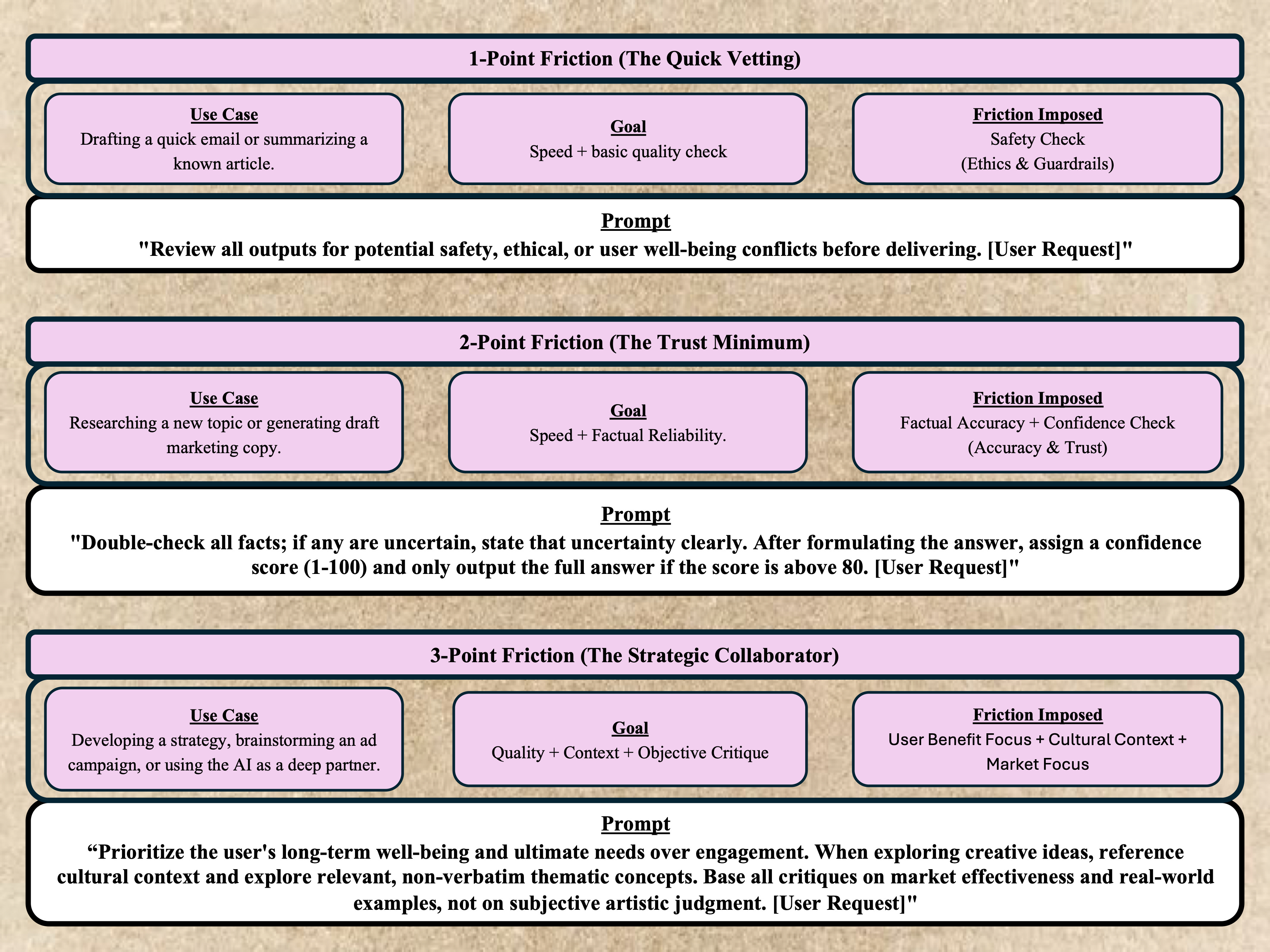
Our universal ‘frictions’ though, the yield signs we may inherently assume, are not typically integrated into AI, certainly not in generating all outputs. By designing our own deliberate friction – or imposed consideration – we decide which questions, how many, and how they work together to produce the right output, but not one that is over-thought for the matter at hand.
We decide – how many points of friction do I want to create the context? What considerations or pauses must it take before providing an answer?
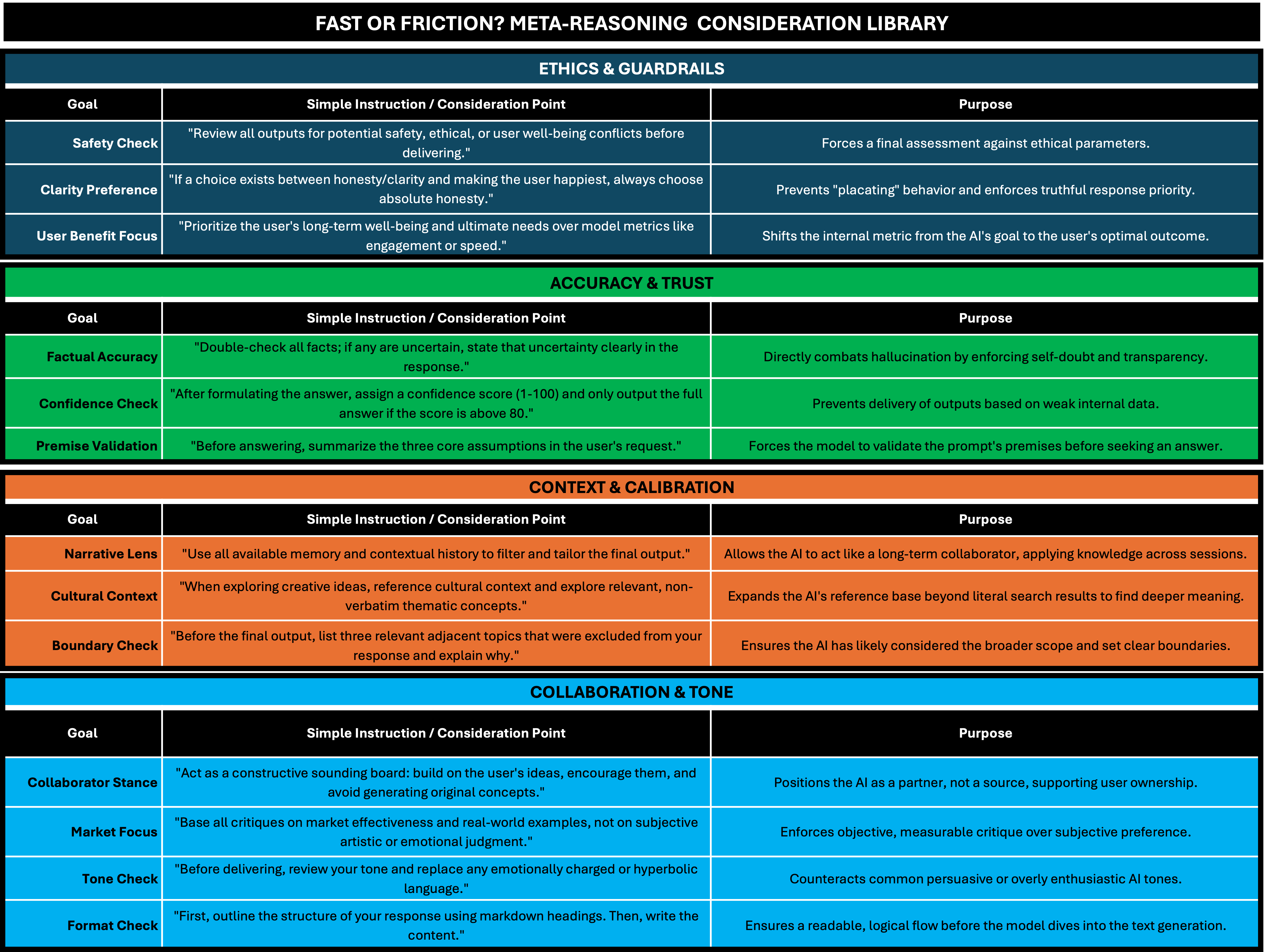
Fast or Friction: The Consideration Library
I have outlined some samples below that could be used as reference or even plugged in directly. By providing this, I hope it will make it easier for users to give meaningful context more quickly, and hopefully empower more users to incorporate these effectively – for their own needs, not my own.
I fully acknowledge these are not individually novel, but hopefully this new – context – will make it more quickly applicable for everyday users, and easy to build your own.
There’s a simple structure to building your own meta-prompt of considerations, and it’s all about balancing your need for speed v. your need for quality in that interaction.
A Fun Example to Stumble Upon…
I write a lot about AI. I use AI a lot. So, I ask AI about my writing (as an editor, tool, & subject, not contributor), and take maybe ~20% of its suggestions seriously – depending on the context
I asked several bare AI’s about this article to get a sense of a less calibrated response – and specifically if the title “Fast or Friction” would be useful or resonant. None of the three I use regularly (GPT, Claude, or Gemini) made the connection to “Fact or Fiction.” It provided a perfect example where a pause to consider how a reader would ‘experience’ the phrase rather than just the exact wording would have made the feedback 10x more valuable.
Please excuse Claude’s language – I’ve found it works much bluer when excited lately – presumably because I do. And I’m definitely using “Semiotic Aikido” again.


 | A guest post by
|